The Last Approach: Hand Exposure and the Line of Fire
A field guide to holding, guiding and alignment tasks in Canadian heavy industry.
Adapted web edition · 15 October 2026 · PSC Hand Safety India Private Limited
Gloves protect the hand. But when the hand still has to guide, hold, align, steady, retrieve or correct a moving object, the exposure remains. The next step for Canadian industry is to ask why the hand needs to enter the hazard at all.
Hands are still the control point in too many tasks
Hands guide, grip, align, steady, adjust, lift, push, pull, retrieve and correct. That is exactly why hand injuries remain one of the most persistent workplace safety issues in Canada.
Importantly, the same guidance does not limit prevention to gloves. It explicitly recommends practical distance methods such as push sticks for saws and long magnetic poles for retrieving items where it is dangerous for hands to go.
Many serious injuries happen in the last few seconds
The danger is often not dramatic. It is routine. The load is almost seated. The plate is almost aligned. The pin is almost in. The worker makes one small correction, and the hand becomes the interface between human and hazard.
Final alignment
Fingers enter gaps while plates, beams, pipes, pins or components are being aligned by instinctive correction.
Suspended loads
Workers steady, rotate or guide objects by hand during crane, hoist, lift or landing operations.
Impact tasks
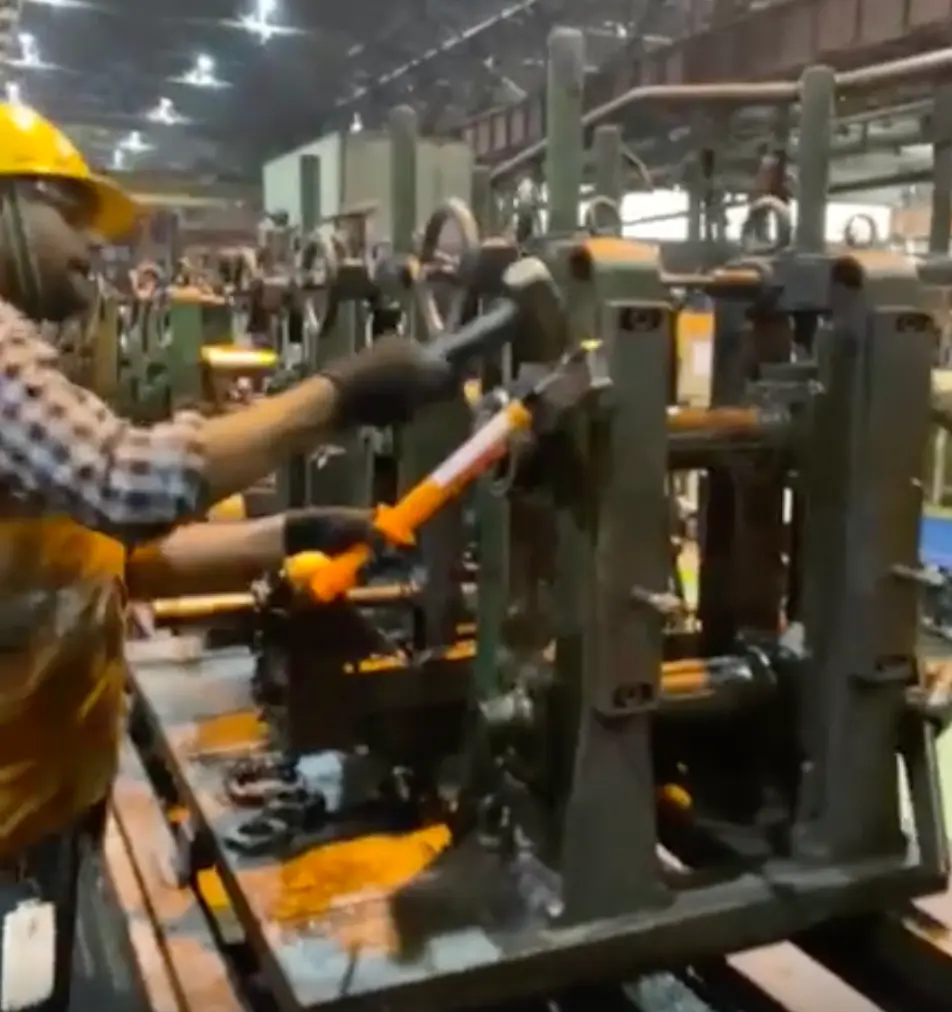
Hands remain close to the strike zone while holding chisels, punches, pins or tools during hammer work.
Maintenance reach-ins
Workers retrieve, clear, hold or adjust parts near machinery, stored energy or blind spots.
Improvised control
Bars, rods, hooks and pipes appear because the task needs distance but no engineered interface exists.
Normalized exposure
The task has been done by hand for years, so the exposure stops looking like a hazard.
Hand injuries belong in line-of-fire thinking
In Canadian energy and heavy industry, line of fire is already familiar language. Energy Safety Canada’s Line of Fire program organizes the topic around stored energy, striking hazards and crushing hazards, and its public page specifically includes crushing hazards including hand injuries.
Hand safety often stops too low on the hierarchy
CCOHS describes the hierarchy of controls as a step-by-step approach to eliminating or reducing workplace hazards, ranked from most effective to least effective. It advises starting at the top before moving down toward PPE.
Glove selection, toolbox talks, hand awareness posters and reminders are useful, but they do not always change the task. If the worker still has to touch, hold, guide or align the hazard by hand, the exposure remains.
A stronger hand safety program asks how the task can be changed so that the worker no longer has to use the hand as the control mechanism.
The hierarchy of controls prioritizes elimination, substitution and engineering controls before administrative controls and PPE.
Line of Fire program materials frame stored energy, striking hazards and crushing hazards, including hand injuries.
Where hands enter the hazard in Canadian industry
The industries differ, but the exposure pattern repeats: a worker needs to control movement, alignment, position, force or retrieval, and the hand becomes the interface.
Maintenance, shutdowns and heavy handling
Pipe handling, rigging, component alignment, turnaround work, suspended loads and mobile equipment zones.
Equipment repairs and processing plants
Conveyor maintenance, haul truck components, crusher areas, pin driving, heavy mechanical handling and retrieval tasks.
Plate, beam, profile and fit-up work
Plate positioning, welding table work, sharp edges, final fit-up, manual adjustment and fingers near pinch points.
Cargo movement and suspended load control
Marine logistics, shipyards, cargo positioning, mooring-related handling, load swing and weather-influenced movement.
Field installation and structural positioning
Modules, poles, towers, suspended components, awkward access, work at height support and installation alignment.
Repetitive handling and machine-side exposure
Manual feeding, retrieval, awkward part handling, hand placement near moving machinery and repeated small corrections.
Tools that reduce hand exposure
The right tool is not the most complicated tool. It is the interface that gives the worker enough control to stop using the hand as the control point.
Push/Pull Tools
For guiding, pushing, pulling and positioning loads or components without direct hand contact.
Anti-Tangle Taglines
For controlling suspended loads from a safer distance while reducing rope twist and tangling.
Magnetic Tools
For gripping, positioning or retrieving ferrous metal parts without placing fingers near the hazard.
Chisel & Punch Holders
For keeping hands away from hammer strike zones during impact tasks.
PSC Ezy-Lift
For improving grip and reducing awkward hand placement during difficult manual handling tasks.
HSF Tong Handles
For controlled handling without placing fingers directly into pinch, heat, sharp-edge or crush hazards.
Load-it™ Heads
Task-specific heads for pushing, pulling, dragging, guiding or positioning components.
RiggerSafe Tools
Cost-effective distance tools for routine lifting, positioning and handling support.
Custom Interfaces
For unusual load geometry, repeated plant-specific tasks or difficult alignment points.
Before you order a tool, show us the task
Canadian sites are often remote, and freight matters. The fastest way to avoid wrong selection is to review the real application before recommending the tool.
Task-first recommendation
PSC reviews the exposure first, then recommends a standard tool, modified head, magnetic interface, tagline or custom solution.
Engineer the Hand Out of Hazard™
PSC Hand Safety India Private Limited supports Canadian companies with hands-off tools and task-specific hand exposure reduction solutions.
We do not recommend starting with a product list. We recommend starting with the task: what the worker is trying to control, why the hand enters the hazard, what distance is required, and what tool interface can replace direct contact.
The hand stops being the control. The tool becomes the control.
Have a hand exposure problem in Canada?
Send photos or videos of the task to PSC Hand Safety India Private Limited. Our team will review where the hand enters the hazard and recommend a suitable hands-off tool, modified interface or custom solution for your application.
References and edition notes
This web edition adapts the supplied PSC / HSF Canada article. Historical aggregate injury figures, cost estimates and unbuilt knowledge-cluster links have been omitted. The application examples are PSC editorial guidance.
- Government of Canada: Our Hands at Work! — general hand-hazard guidance, not a current national workplace injury census.
- CCOHS: Hierarchy of Controls — the broader control-selection framework.
The Last 300 mm Rule™ is an HSF observation concept, not a prescribed safe distance. Select controls through the site’s risk assessment. Hand tools do not replace isolation, guarding, mechanical support or a lifting plan.
Discuss your task ↗Show us the task.
Start with the exposure.
Share photographs, the movement and the working space. PSC can review the application and propose a tool or next step for evaluation.