Hand Injuries in Canada: Beyond Gloves
A practical framework for recognising hand exposure and selecting task-specific controls.
Adapted web edition · 15 October 2026 · PSC Hand Safety India Private Limited
Canada already documents the problem. Canada already buys the gloves. Hand injuries remain among the most common workplace injuries in the country. This article argues that the next safety frontier is not better hand protection — it is eliminating the exposure itself.
This is not a small or marginal problem. It is a systemic one — and it persists despite decades of safety training, expanded PPE standards, glove technology investment, and awareness campaigns. The question worth asking is why.
The answer this article proposes is straightforward: most Canadian workplace hand safety programmes are designed to protect the hand after it has entered the danger zone. The better approach — and the one this article argues for — is to reduce the number of times the hand enters the danger zone at all.
This is the distinction between hand protection and hand exposure elimination . It is not a semantic difference. It is a structural one, with material consequences for injury frequency and severity.
"The question is no longer which glove should the worker wear. The better question is: why is the worker's hand still required at the hazard interface?"
The human cost is not measured in statistics alone. A hand injury does not only remove a worker from a job. It reduces manual capacity, sometimes permanently. It affects daily life outside work — the ability to hold a child, perform household tasks, or engage in recreational activities. For workers whose occupation is physically intensive, a permanent hand injury can end a career.
Where Canadian Workers Get Hurt
One of the highest-frequency environments for hand injuries in Canada. Machinery guarding failures, caught-in and caught-between incidents, material handling, die changes, press operations, and maintenance activities all generate hand exposure at high rates.
Remote sites, heavy equipment, high-torque maintenance operations, and the handling of large components in confined spaces create serious hand exposure in mining. The Mining Association of Canada recognises hand and finger injuries as a leading injury type across the sector.
Pipe handling, valve installation, equipment positioning, and maintenance operations on wellsites and at processing facilities generate high volumes of hand exposure — often in conditions of time pressure, extreme temperature, and fatigue. Tubular handling is a particularly documented hand injury source.
Canada's forestry sector is among the highest-risk industries for hand and upper extremity injuries. Saw work, material handling, log positioning, and equipment maintenance all generate significant hand exposure — frequently in remote, variable-terrain environments where formal tool provision is inconsistent.
Container terminals, marine cargo operations, and heavy freight handling all involve suspended loads, crane operations, and cargo positioning tasks that place hands consistently in line-of-fire and crush-point zones. The high-tempo nature of terminal operations increases the pressure to handle loads by hand.
Gloves Are the Last Line of Defence. In Canada, We Are Treating Them as the First.
Every serious Canadian EHS professional understands the hierarchy of controls. Elimination first, then substitution, engineering controls, administrative controls, and finally PPE. The framework is well-established, widely referenced, and consistently endorsed by CCOHS, provincial OHS regulators, and the Canadian Standards Association.
And yet, the dominant response to the Canadian hand injury problem remains a PPE response. Hand injury rates rise; glove procurement budgets increase. An injury occurs; the conversation turns to which glove should have been worn. The data shows persistent injury rates; the proposed intervention is a new glove specification.
This is not a criticism of gloves. High-quality, task-appropriate gloves are a necessary part of any hand safety programme. The criticism is of a safety system that has placed PPE at the centre of its hand protection strategy rather than at the end of it.
What Gloves Cannot Do
A glove cannot prevent a hand from entering a pinch point. It cannot reduce the force of a suspended load that shifts, swings or drops unexpectedly. It cannot stop a crush injury when a component is lowered onto a hand that has drifted inside the exclusion zone. It cannot prevent the catastrophic outcome when a hand is between a moving component and a fixed structure and the load moves.
The hierarchy of controls is not being abandoned in principle. It is being bypassed in practice. When a company's hand safety programme consists primarily of a glove policy, a toolbox talk, and a hand injury awareness poster, the hierarchy has effectively been reduced to its final step.
The engineering control question — what can be physically placed between the worker's hand and the hazard? — is often not asked. Not because the answer is unavailable, but because asking it requires a different kind of thinking: not "how do we protect the hand after it enters the zone?" but "how do we prevent the hand from entering the zone at all?"
"Hand safety cannot stop at PPE. A glove is not a control. It is the acknowledgement that all controls have been exhausted — or skipped."
Hand Exposure: The Variable That Injury Statistics Don't Measure
An injury only occurs after exposure. Exposure is the moment the hand enters the hazard zone. Most safety programmes measure injuries. Almost none measure exposures.
Hand Safety First® uses a specific framework for understanding where hand exposure occurs. Four concepts form the foundation of this framework:
Where Canadian Workers Place Their Hands
The exposure mechanisms that generate the most serious hand injuries across Canadian industry are not random. They are concentrated in a predictable set of task types. Each represents a moment where the hand is either required — or believed to be required — at a hazard interface:
The Last 300 mm Rule™ — codified in HSF exposure doctrine — identifies the final phase of any lift or positioning task as the highest-exposure moment. It is the zone in which taglines are no longer effective, engineering distance has typically collapsed to zero, and the worker's hand becomes the default control surface. This is the zone that gloves cannot protect and that engineering controls must address.
If You Only Measure Injuries, You Only See the Past
The structural problem with injury-based safety management is that it treats the symptom — the injury — rather than the cause, which is the exposure. A worker whose hand enters a pinch zone 50 times in a shift has experienced 50 exposure events. If none of them result in an injury that day, the safety metric shows zero. The next shift, the same 50 exposures occur. Eventually, the statistics catch up. The outcome appears sudden and surprising; the exposure was routine and predictable.
This is the pattern that drives the persistent hand injury problem in Canadian industry. Exposure is normalised. The toolbox talk says "be aware of your hands." The workers are aware. They are also working under time pressure, using the tools they have been given, performing tasks the way they have always been performed. Their awareness does not change the geometry of the hazard.
"An injury is an exposure that completed its consequences. The exposure occurred before the injury. The exposure is what must be measured and managed."
Hand Exposure Mapping™
The alternative to injury-based thinking is exposure-based thinking — and its practical tool is Hand Exposure Mapping™. Rather than asking "where did the injury happen?", Hand Exposure Mapping™ asks: "where does the hand enter the hazard zone during normal work?" The answer is found not in incident reports but in task observation — watching the actual sequence of a die change, a pipe pick, a suspended load landing, a maintenance task.
What is typically found is that hand exposure is not occasional and random. It is frequent, predictable, and concentrated in a small number of task types that repeat across every shift. Mapping those tasks — identifying the specific exposure moment within each one, and then asking what engineering control could prevent the hand from reaching the hazard interface — is the foundation of a serious hand safety programme.
The practical output of Hand Exposure Mapping™ is a prioritised list of exposure points that can be addressed through engineered controls — tool provision, process redesign, mechanical aids, or physical barriers — rather than through continued reliance on worker awareness and PPE.
A Hand Safety Programme That Honours the Hierarchy of Controls
The hierarchy of controls is not controversial. It is the foundation of occupational health and safety regulation in every Canadian province and territory, endorsed by CCOHS, the Canadian Standards Association, and every credible EHS framework. The problem is not ignorance of the hierarchy. The problem is that, for hand safety specifically, the hierarchy is regularly inverted in practice — with PPE treated as the primary control rather than the last resort.
A hand safety programme that genuinely honours the hierarchy looks like this:
Redesign the task so that the hand is not required at the hazard interface. Can the load be positioned mechanically? Can the component be guided without hand contact? Can the die change be automated? Elimination is the highest-value control and should always be examined first.
Replace the hazardous process with a less hazardous one. Can a lighter component replace a heavy one, reducing crush risk? Can a different assembly sequence reduce the number of hand-exposure moments in a maintenance task?
Place a physical control between the worker's hand and the hazard. Push-pull tools, load guidance systems, magnetic positioning aids, impact holders, mechanical guides, and barriers. Engineering controls do not rely on worker compliance. They achieve separation by design. This is the level where hand safety programmes most consistently underinvest.
Procedures, permits, task observations, and training that define how the task is performed, who may perform it, and under what conditions. Administrative controls reduce injury probability through compliance — which is less reliable than engineering.
The last line of defence. Necessary. Never sufficient alone. A glove that is specified as the primary hand safety control for a task where an engineering control is available is not a safety programme — it is a documentation exercise.
Why Engineering Controls Dominate in Serious Safety Programmes
Engineering controls are superior to administrative controls and PPE for a structural reason: they do not require the worker to do something additional. An impact holder that keeps a worker's hand away from the striking zone works every time the tool is used — regardless of fatigue, distraction, time pressure, or supervision. A procedure that tells the worker not to hold the chisel while someone else strikes it requires consistent compliance under conditions that are specifically hostile to compliance.
High-performing safety organisations have understood this for decades. The shift from procedure-dependent to engineering-dependent safety is the same shift that transformed process safety after major industrial events. It is the shift that is now needed for hand safety.
The Architecture of Distance™ — an HSF doctrine principle — holds that physical separation between the worker's hand and the hazard must be designed into the task, not relied upon as a behavioural outcome. Instruction asks for compliance. Engineering achieves separation. These are not equivalent interventions.
No-Touch Safety: Engineering Distance Into the Task
The concept of no-touch safety — designing work so that the worker's hand never needs to contact the hazard — is not new. What is new is the availability of purpose-designed engineered tools that make it practically achievable across a far wider range of industrial tasks than was previously possible.
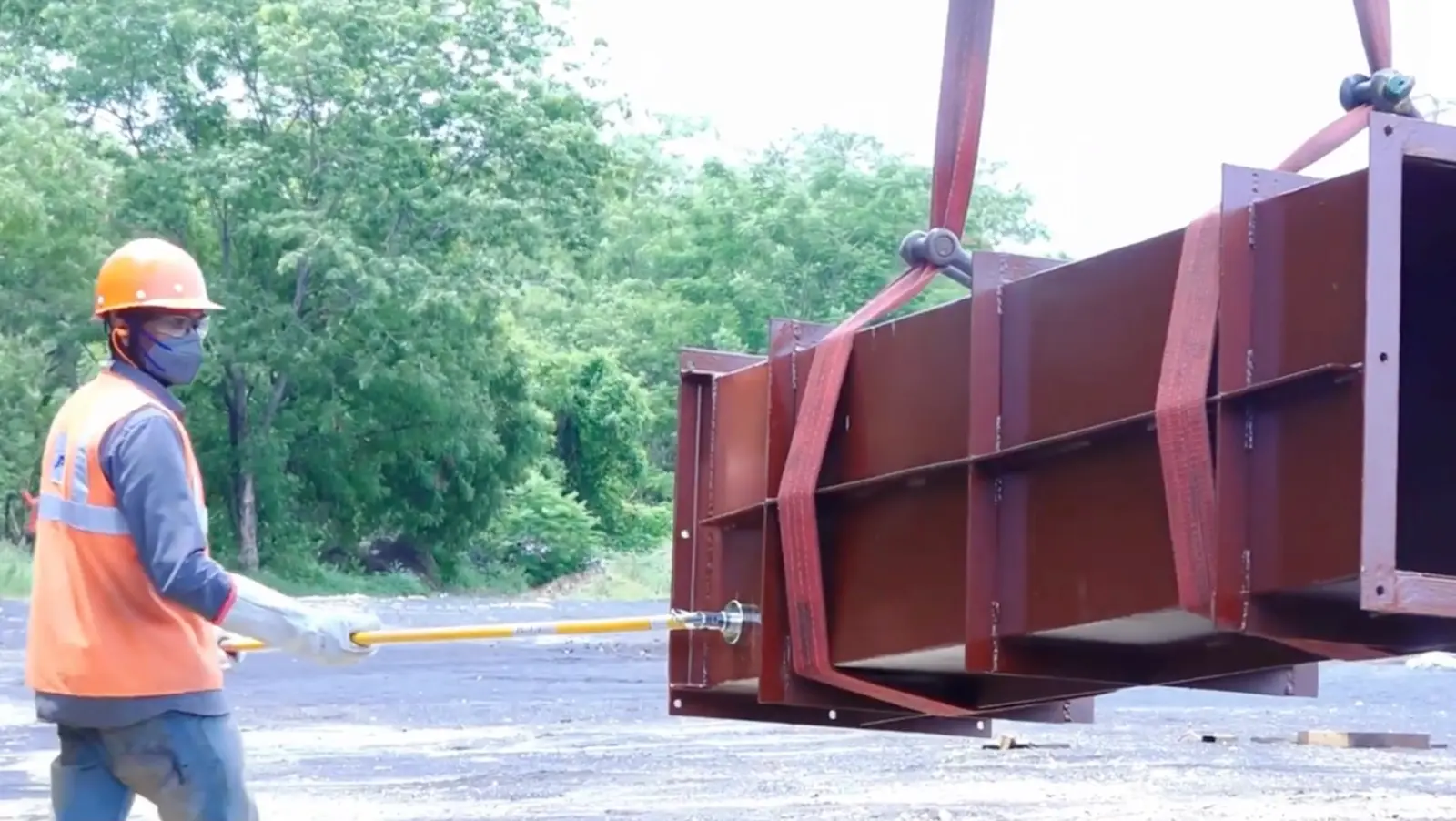
No-touch safety systems are engineered tools that interpose a physical interface between the worker's hand and the hazard. The worker remains in control of the task. The tool provides the mechanical interface. The hand remains outside the exposure zone.
The range of task types that can be addressed by no-touch engineered tools is broader than most Canadian safety professionals currently recognise:
These tools do not replace the worker's role in the task. They replace the worker's hand at the specific moment when the hazard exists. The worker still directs the operation, assesses the geometry, and makes the positioning decisions. The tool is the interface.
Distance Before Contact™ — the HSF principle that physical separation between the worker and the hazard must be the default approach, not the exception. A no-touch system does not ask the worker to step back. It gives the worker a tool that makes stepping back the natural working position.
The adoption of no-touch safety systems in Canadian industry is currently uneven. Oil and gas operators, driven by Life Saving Rules frameworks and critical lift procedures, have the most developed approach. Construction, mining, ports and manufacturing are at earlier stages of recognising that purpose-designed engineering tools for hand exposure reduction are a different category from standard rigging accessories or general-purpose tools.
"The hand that never enters the danger zone is the hand that never gets injured. No-touch is not a philosophy — it is an engineering specification."
Where Canadian Work Exposure Meets Engineered Controls
The table below maps Canadian industry sectors to their primary hand exposure moments and identifies the category of engineered control relevant to each. The tool families referenced are examples of engineered controls — not an exhaustive product list — and are described in detail in Section 15.
References and edition notes
This web edition adapts the supplied PSC / HSF Canada article. Historical aggregate injury figures, cost estimates and unbuilt knowledge-cluster links have been omitted. The application examples are PSC editorial guidance.
- Government of Canada: Our Hands at Work! — general hand-hazard guidance, not a current national workplace injury census.
- CCOHS: Hierarchy of Controls — the broader control-selection framework.
The Last 300 mm Rule™ is an HSF observation concept, not a prescribed safe distance. Select controls through the site’s risk assessment. Hand tools do not replace isolation, guarding, mechanical support or a lifting plan.
Discuss your task ↗Show us the task.
Start with the exposure.
Share photographs, the movement and the working space. PSC can review the application and propose a tool or next step for evaluation.